Showing posts with label Secular Pro-Life. Show all posts

Monday, March 11, 2013

Aborting to protect our bodies?


We hear a lot about bodily rights during the abortion debate. Moving beyond the abortion debate to society in general, I think it's clear that bodily rights are fundamental. It seems most other pro-lifers think it's clear too. You'll be hard-pressed to find a pro-lifer that says they'd be fine with laws forcing drivers to donate blood to people they hit with their cars, or even requiring parents to donate kidneys to their sick children.

Yet when we are discussing abortion, it seems to me a lot of pro-lifers tend to avoid the bodily rights argument. They brush off the "my body my choice" assertion as a cop out, a cover up for less noble justifications. I've seen many pro-lifers respond to the bodily rights argument with disgust or bewilderment, claiming it's a bunch of mental gymnastics, a twisted, desperate attempt to justify a horrible act. After denouncing bodily rights as a red herring, they see no reason to consider or discuss it.

Of course this doesn't apply to the entire pro-life movement; there are plenty of pro-lifers who try to explore the moral distinctions between pregnancy and allegedly analogous situations. Still, in my experience it seems too many pro-lifers haven't seriously considered--and in some cases refuse to consider--how much bodily rights do play into the abortion debate. Sometimes I'm surprised by this, because the issue of bodily rights weighs heavily in my consideration of my abortion stance.

I wonder if pro-lifers dismiss the bodily rights argument partly because it's not usually why women get abortions in the first place. While bodily autonomy is a commonly cited reason for keeping abortion legal, it's not a commonly cited reason for actually getting an abortion.

According to Guttmacher:
The reasons most frequently cited were that having a child would interfere with a woman's education, work, or ability to care for dependents (74%); that she could not afford a baby now (73%); and that she did not want to be a single mother or was having relationship problems (48%).
Not mentioned is a concern for bodily health, or a frustration or fear over sharing her body with another.

The Guttmacher report elaborates:
In a 1985 study of 500 women in Kansas, unreadiness to parent was the reason most often
given for having an abortion, followed by lack of financial resources and absence of a partner. In 1987, a survey of 1,900 women at large abortion providers across the country
found that women’s most common reasons for having an abortion were that having a baby would interfere with school, work or other responsibilities, and that they could not afford a child.
Again, the main reasons women choose abortion have nothing to do with their bodily autonomy.

Still, that doesn't mean bodily autonomy is irrelevant to these women. Guttmacher found that 12% of women cite concerns over their health as cause for an abortion, including "from chronic or debilitating conditions such as cancer and cystic fibrosis to pregnancy-specific concerns such as gestational diabetes and morning sickness."


Why is there such a divergence between the reasons people insist abortion should be a right and the reasons women actually get abortions? Does the difference matter? Are there parallel differences between the reasons people protect other rights vs the reasons people exercise those rights?

[Re-posted on Secular Pro-Life]

Saturday, March 2, 2013

Can I be a feminist too?


I consider myself a feminist. I’m a big proponent of women going to college and building their own careers (and I’d like to see more female scientists). I’m very big on a balance between our relationships and the rest of our lives; you should not be made or broken by whether you're single or dating or married. I think society concentrates far too much on our looks, too little on our minds. I’m a huge advocate of expecting and demanding respect from others, particularly from romantic interests. I believe empowered women include women who value themselves, and expect their partners to value them as well. Cruelty, indifference, derision, dishonesty—I hate seeing people tolerate poor treatment, especially due to a fear of being single. I also hate victim-blaming. I’m grateful my boyfriend, brothers, and guy friends understand that the standard is not "it's okay as long as she doesn't say 'no'" but rather "it's not okay unless she says 'yes.'" I’d love for a lot more people to understand this.

I consider myself a feminist. I’m humbled by the women who’ve gone before me, who helped create the opportunities I enjoy today. I’m proud of and inspired by the women who fought for my ability to vote, get an education, own property, access birth control, serve in the military, hold political office, stand up to sexual harassment, graduate from college, and on and on. I feel grateful to modern role models who speak out against ridiculous body expectations, or sexual expectations, or what have you.

Oh, Jennifer Lawrence :-)

I consider myself a feminist and my heart and mind go out to fellow feminists in many respects. I'm glad to be a part of our movement toward equality, making the world better for my daughters. I feel a kinship with the men and women who also work toward that goal.

But then we turn to the topic of abortion, and suddenly I’m shoved right out of the feminist movement and into an ill-fitting stereotype. Apparently pro-life women hate sex and (simultaneously, somehow) think women have a duty to procreate. Apparently, because I'm pro-life I don’t believe our gender can or should make our own decisions. Supposedly I don’t think women should have their own educations, careers, or lives outside of the kitchen (or the bedroom). I'm told I don’t even care if women die. I'm told, in fact, that I hate women, including myself. All of the gender issues I care about so deeply are a farce, smoke and mirrors to hide my backward, misogynistic, sinister agenda of reducing my gender to a bunch of baby incubators.

In reality, I'm pro-life because I believe the non-defensive killing of other human beings is wrong. How sad that this perspective is enough to destroy my credibility as a feminist. 

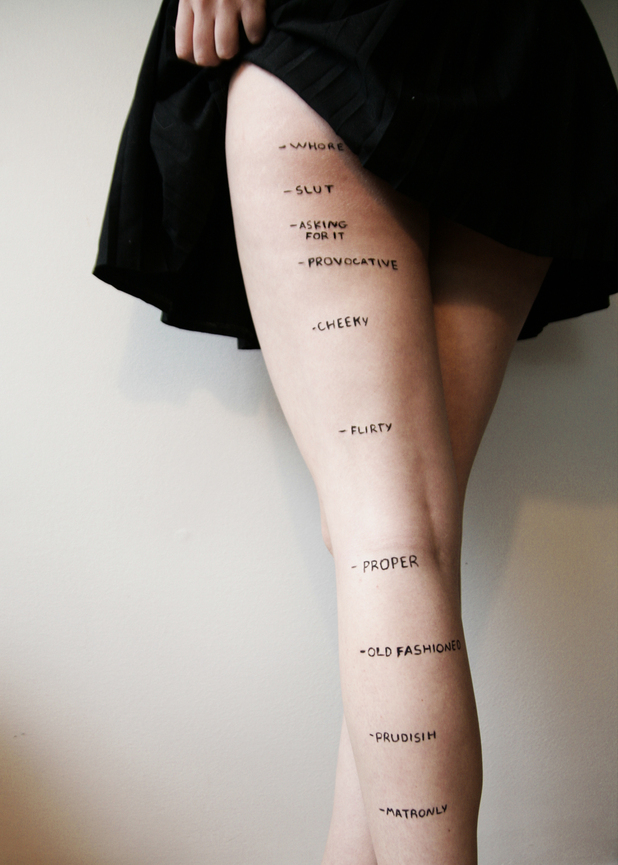
The truth is I think women should have control over their bodies, and that their sexual decisions should be their own. I think consenting adults should be free to have sex with whomever. I'm glad we live in a society in which birth control is legal and common, and I'd like to see better sex education so more people will use birth control effectively. I really dislike the double standards society has regarding men and women's sex lives. (For example, the phrase "man-whore" irritates me because it seems to imply that normally women are "whores," so in this case we have to clarify.) I can't stand the "slut vs. prude" dichotomy, as if women can only be one or the other, and we sure can't win either way. 

Choose your stereotype.
 
I also don't believe anyone has a duty to procreate, and I would love it if no one got pregnant who didn't want to be pregnant.

I do believe, though, that once a woman is pregnant, things have changed. I see a huge moral difference between preventing a pregnancy and terminating one, because I recognize the human fetus as part of our species, warranting protection. 

I don't take this position lightly. I understand how dramatically pregnancy, childbirth, and child-rearing alter women's lives. Indeed I think part of feminism is transforming society so that procreation doesn't affect women so disproportionately. We need better maternity leave and childcare options. We need to break down stigmas surrounding single, student, and working mothers. I'd love to live in a society where employers understand that supporting their pregnant and parenting employees means supporting productive citizens and healthy families. If our society had better support for pregnancy and child-rearing, I believe less women would feel compelled to choose abortion in the first place. 

But in any case, I flatly reject the idea that only when women are able to have their offspring killed can we have the same opportunities as men. If that's equality, it's an abysmal form.

I consider myself a feminist, and I'm pro-life. I know I'm not the only one.


[Re-posted at Secular Pro-Life]

Wednesday, January 30, 2013

Unborn Parasite?

Disclaimer: I know both pro-choicers and pro-lifers who understand fetal development. The following post is not meant to address everyone, but to specifically address the people who remain ignorant.

Mary Elizabeth Williams at Slate.com wrote a piece explaining that she understands abortion takes a human life, but that "some lives are worth sacrificing." Obviously I disagree with her general take, but I thought this paragraph was quite true:
I have friends who have referred to their abortions in terms of “scraping out a bunch of cells” and then a few years later were exultant over the pregnancies that they unhesitatingly described in terms of “the baby” and “this kid.” I know women who have been relieved at their abortions and grieved over their miscarriages. Why can’t we agree that how they felt about their pregnancies was vastly different, but that it’s pretty silly to pretend that what was growing inside of them wasn’t the same? Fetuses aren’t selective like that. They don’t qualify as human life only if they’re intended to be born.
It's no secret that most people make decisions based on emotions more than rational thought. One side tends toward the vague and impersonal (clump of cells, products of conception) or hostile (parasite, invader) while the other side goes with the personal (daughter, son, child) and helpless (preborn, unborn, baby). And so on.

I've seen pro-choicers mock pro-lifers for using photos of full grown babies, pointing out that the majority of abortions take place before 8 weeks gestation, and accusing pro-lifers of playing emotional manipulation by confusing everyone as to what's actually being destroyed here. I've heard pro-lifers loudly wonder why pro-choicers never depict fetal development at all, pointing out that pro-choicers tend to leave the fetus out of the equation entirely, and claiming pro-choicers deceive people with a "nothing to see here, folks" approach.

Of course what the fetus "looks like" should have about zero bearing on whether the fetus deserves rights or protection, but for the record:


If pro-lifers only used pictures of actual embryos and early-stage fetuses, do you think it would change the abortion debate? Do you think it would be a good idea? Is it more important to be emotionally captivating or precisely accurate?

[Re-posted on Secular Pro-Life]

Thursday, January 24, 2013

Thoughts on polling and labels.

Even as Planned Parenthood moves away from the "Pro-choice" label, more Americans are adopting it. Again. 

According to Gallup 48% of Americans describe themselves as "pro-choice," compared to 44% who describe themselves as "pro-life." Yet only last year Gallup reported a record low number of self-described pro-choicers (41%, compared to 50% "pro-life"). That's a lot of fluctuation, and (again according to Gallup's trends) the labels have been fluctuating for several years now.

Depending on which way the percentages move, one side of the other will emphasize the poll and talk about long-term, big-picture changes in the never-ending national abortion debate. Maybe they're right, but I don't think we can really see that from these polls. 

Labels like "pro-life" and "pro-choice" are not as well-defined as abortion activists like to suggest. I suspect people's reasons for choosing one label or another have to do with a lot of factors beyond their perspective on abortion specifically. For example, some pollsters suggest recent changes may be due to ignorant Republican comments about rape and pregnancy, or due to last year's contraception debates. I also suspect adherence to pro-choice and pro-life labels have a lot to do with how people feel about the Democrat and Republican parties at a given time, even if their feelings about the parties change due to topics other than abortion.

And of course there's a lot of ambiguity about what the terms "pro-choice" and "pro-life" imply. To my mind, a pro-choice person is someone who believes, at minimum, that women should be able to get abortions for any reason during the first trimester, and for severe reasons (rape, life/health of the mother, fatal fetal abnormalities) in the second two trimesters. A "pro-life" person is someone who believes, at minimum, that abortion should be illegal throughout all stages of the pregnancy except for those severe reasons. There are more "pure" pro-choicers and pro-lifers who may argue that the above definitions compromise too much, but my point here is not ideological purity. I'm trying to summarize what I think the majority of people in the abortion debate would consider "pro-choice" or "pro-life."

Yet I've met people who think that they are technically pro-choice because they believe in exceptions for rape and life of the mother. And I've met plenty of "personally pro-life" people who think abortion is a necessary evil that should be legal. How do people like these respond to polls?

Meanwhile, as Secular Pro-Life has pointed out, a recent Pew Research Poll found only 62% of adults knew Roe v. Wade was about affirming a woman's right to an abortion. In fact, 17% of adults thought the case had to do with school desegregation, the death penalty, or environmental problems. I don't really blame them--if you're not passionate about abortion I can understand not knowing anything about Roe v. Wade. I'd be hard-pressed to name a landmark SCOTUS decision about the environment.

Still, I wonder how much national ignorance plays a roll when Gallup asks people whether they thought Roe v. Wade should be overturned (53% said no, 29% said yes, and 18% said they don't care).

It's also interesting how the "pro-choice" and "pro-life" demographics break down:


Religion.

Having no religion is the biggest predictor for being pro-choice--bigger, even, than being liberal. Note, though, that the intense correlation doesn't cut both ways: 80% of the nonreligious are pro-choice, yet only 50% of non-Catholic Christians and 45% of Catholics are pro-life. In fact, more Catholics called themselves pro-choice than pro-life! And yet we're allegedly a Catholic movement?


Politics.

73% of liberals and 63% of Democrats call themselves pro-choice. 63% of conservatives and 67% of republicans call themselves pro-life. I never have been that clear on the distinctions between liberal/Democrat and conservative/Republican. They seem to generally follow the same polling trends. In any case this still leaves roughly 1/3 of Democrats who don't consider themselves "pro-choice" and 1/3 of Republicans who don't consider themselves "pro-life." If the labels weren't so strongly associated with specific political parties, how might that change peoples' self-descriptions?


Education.

The more college education a person has, the more likely they are to say they're pro-choice. Other polls have shown the more college education a person has, the less religious that person tends to be. And it's no surprise that education is positively correlated with income. In other words, while it's clear that education and the "pro-choice" label are correlated, it's not clear whether (a) increased education causes people to be pro-choice, (b) being pro-choice makes it easier for people to increase their education (how many women cite disruption to their education as a reason to get an abortion?), or (c) being pro-choice and being well-educated are both correlated with some third causal factor, like being non-religious.


Income.

I think this factor surprised me the most. According to Guttmacher, 73% of women who get abortions cite financial problems as a major reason. Yet the less income a person has, the less likely they are to say they're "pro-choice." I'm not sure what to make of that.


I would love to see a poll that asks more about the legality of abortion, and less about labels. It should also ask not just whether abortion is moral or immoral, but why respondents think it's moral or immoral. Maybe that would shed more light on the national perception of the abortion debate.

Re-posted at Secular Pro-Life

Monday, January 14, 2013

PP moves away from "pro-choice" label.

Planned Parenthood is moving away from the term "pro-choice" in response polls showing dissatisfaction with abortion debate labels.
"I'm neither pro-choice nor pro-life," said one woman in a focus group commissioned by Planned Parenthood. "I'm pro-whatever-the-situation is." Said another, "there should be three: pro-life, pro-choice and something in the middle that helps people understand circumstances [...] It's not just back or white, there's grey."
Over at Slate magazine, Amanda Marcotte was frustrated with this response.  She claims that people who are "pro-whatever-the-situation-is" are pro-choice.
But if the women mean, as I suspect they do, that they are not pro-abortion but rather pro- a woman being able to make her decision based on her circumstances, that is the very definition of pro-choice.
This is also my understanding of the term "pro-choice." And I expect it's the understanding of most pro-choice activists. But is that how the term "pro-choice" translates to the general public--to people who aren't particularly involved in the abortion debate? Based on Planned Parenthood's research and response, it seems a lot of people hear "pro-choice" and feel it implies something more, a stronger stance.

It'll be interesting to see whether Planned Parenthood can transcend abortion debate labels. I think labels help people succinctly explain their perspectives; it just gets cumbersome trying to impart all the nuance every time you speak on a topic. I think the labels "pro-life" and "pro-choice" are going to be around for a long while still, but if they're not, I'm interested to see what takes their place.

 [Re-posted at Secular Pro-Life]

Wednesday, November 21, 2012

Abortion and Rationality

Philosophers have proposed, and studies have suggested, that people form opinions based on their emotions first, and after the opinion is formed they find a way to rationalize it.

Emotion ---> Opinion! ---> Rationalization

We may like to believe we first carefully think about the logic behind ideas, then form our opinions, and then let our emotions follow the conviction of our rational minds. And maybe some people do that, or at least do it better than others.

Thoughts ---> Opinion! ---> Emotions

Or maybe the emotions do come first, but some people are better at separating out the emotions and forming opinions without them. I'm sure it varies from person to person.

Emotion (set aside) ---> Thoughts ---> Opinion!

Overall, though, I suspect most of us have emotions first, thoughts after. Think about the times you've debated someone about politics or religion or anything else and their counterarguments have been nonsensical. If their thoughts make no sense, why are they so convinced of their perspective? Because it's not their thoughts that guide them. It's their emotions.

The abortion debate is no exception. None at all. I expect people form their opinions based on feelings even more often when an issue is more morally complex. Complexity makes it harder to think it through. And abortion--despite what some  insist--is morally complex.

Perhaps this is part of the reason one side talks much more about abortion in cases of rape, even though those situations account for less than 1% of abortions. Perhaps its the reason the other side uses photos of late-term abortions or late-term fetal development, even though over 90% of abortions are performed in the first trimester. People gravitate toward the extremes, where the morality gets a little less complex, the emotion a little more raw.

I suspect it's also true that opinions formed based on emotion are harder to change than opinions formed based on thought. Perhaps this explains why American views on the morality of abortion haven't varied that much in so long?

[Re-posted at Secular Pro-Life.]

Saturday, November 10, 2012

The Balance

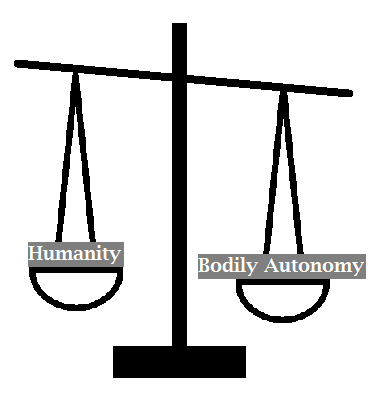
There are many important factors in the abortion debate. I try to weigh all factors in forming my perspective. I am pro-life, but I don't pick the side lightly. It seems the only options are restricting a woman's control over her body or allowing the unrestricted killing of human fetuses. I take both outcomes seriously; something is sacrificed no matter which side you choose, and I think a lot of people recognize that.

But not everyone. A lot of people insist the issue is black and white, that their own view is the only obvious view. I think this happens because--out of the many factors that play into abortion--people decide which factor they think is the most important...and then they refuse to consider anything else.

For example, I've seen pro-choicers say that whether the fetus is a person is irrelevant because no person has the right to use your body against your will. I'd depict their perspective like this:


Similarly, I've seen pro-lifers say that it makes no sense to grant a rape exception because the fetus is a human being no matter how he or she was conceived. I'd depict their perspective like this:


I disagree with both of the above perspectives. I think both the humanity of the fetus and the woman's bodily rights matter. In my opinion, the scale should look more like this:

One factor may still outweigh another, but it won't outweigh by as much as if there were no other factors to consider. We can certainly argue over which factor has more weight, why it has more weight, and how much more weight it has. But those are very different arguments than asserting that only one factor matters at all.

When considering only bodily autonomy and humanity, I believe one person's bodily autonomy does outweigh another person's humanity. After all, we don't require people to donate blood even if it means other people will die without blood donations. We don't do this because your bodily autonomy--your right to decide whether or not to donate blood--is considered more important than the life of a man who will die without a blood transfusion. The dying man still has his humanity--no one is saying he's not a human being--but his humanity doesn't somehow mean you can be forced to donate blood. 

Some people say this does make the dying man's humanity irrelevant. After all, whether he is human or not, you still don't have to donate blood, right? Who cares whether bodily autonomy outweighs humanity a little or a lot--in the end it still outweighs, so why even talk about humanity?

Because humanity and bodily autonomy still aren't the only factors to consider. Other factors must be added to one side of the balance or the other, and the accumulation of multiple factors may tip the scales. For example, what if the man is dying because of you? What if you consented to some action you knew risked putting his life in danger? Maybe then the scale would look more like this:


Take away any one of the factors on the left, and bodily autonomy wins out again. But the combination of factors on the left is another story.

Now, there are actually many, many more factors to consider on both sides of the scale. My point in this post is not to give an exhaustive argument for why I think most abortions should be illegal. My point is simply to say that there are a lot of factors in the abortion debate, and while some of them weigh more than others, they all weigh something. Keep that in mind.

[Re-posted at Secular Pro-Life]

Thursday, November 8, 2012

Pro-Lifers & Birth Control

Gallup says 89% of American adults consider birth control morally acceptable. Gallup also says 50% of Americans describe themselves as "pro-life."

Let's assume all of the other 50% (the people who don't describe themselves as "pro-life") consider birth control morally acceptable. That leaves 39% of Americans who both describe themselves as "pro-life" and consider birth control morally acceptable. In other words, at a minimum, 78% of self-described pro-lifers consider birth control morally acceptable. But you wouldn't know it, would you?

I thought I was a minority in being both anti-abortion and pro-birth control. The polls say most pro-lifers are fine with birth control, so why doesn't it seem that way? I have some theories.

1) Pro-lifers who are more active in the pro-life movement are probably both more vocal and more ideologically "pure." In other words, perhaps the majority of self-described pro-lifers are fine with birth control, but the majority of pro-life activists (the people we hear from the most) are not?

2) "Birth control" is a vague term. There are many different types of birth control, and some are more controversial than others. For example, maybe most pro-lifers think condoms are a good idea but reject the morning after pill. Would they say, generically, that "birth control" is morally acceptable, or no?

3) The religious right is vocal about opposing the birth control mandate. People conflate pro-lifers with the religious right (and there's certainly a correlation, but still it's not quite accurate). People also conflate not wanting to pay for birth control with thinking people shouldn't be allowed to use birth control.

Anything I'm missing? Why do you think there's such a discrepancy between the perceptions of the pro-life movement and what an average "pro-lifer" actually thinks?

[Re-posted on Secular Pro-Life]

Monday, November 5, 2012

Changing Minds

Many people have told me arguing on the internet is a waste of time. I've told other people that myself (not that it stops me at all anyway). Most of the time you are arguing with people who don't have any real interest in exploring your thoughts or their own. Most of the time people just want to "win" and will ignore difficult questions, get sarcastic and defensive in the face of resistance, refuse to acknowledge any decent points at all on the other side, and so on. I'm sure I have done all of these things myself at one point or another.

But sometimes you have conversations with people who really are curious about the thoughts of those they disagree with, and who really are interested in exploring their own thoughts. Even if I don't specifically change my mind by the end, I almost always learn something from those conversations. It's very satisfying.

I think people rarely change their mind over a single conversation. So when others say "I've never seen anyone change their mind about this" I don't find it all that convincing. It's hard to "see" people change their mind, because a lot of times it happens gradually with enough time and opportunity to really digest different viewpoints, try out different arguments with others, test the arguments' strengths and weaknesses, and develop conclusions. I bet a lot of times even the person changing her mind doesn't necessarily realize it's happening right away.

And I've realized recently that, actually, I have changed my mind about many things over the last five years or so, and a lot of that has been due to online debates with people who really wanted to talk it out. Now, rarely have I reversed positions entirely, but even if I don't 180, I suppose I do...90? 45? Even if I still disagree, I at least come to better understand the opposition's arguments.

And maybe people on the other side of the fence find a "90 degree" conversion insufficient, but I think it matters. Consider a topic you feel strongly about. Imagine all the people you know who strongly disagree with you. Now imagine that, tomorrow, all of your opposition came "halfway" around to your view. It'd make a big difference.

I attended an ethics lecture a couple of weeks ago, and the professor claimed people rarely change their minds based only on thinking a lot about a topic--people are more likely to change their minds based on talking a lot about a topic, particularly with a friend who disagrees. He asked us to consider the last time we changed our position on something significant. Why did we do it?

So go on. Why did you do it?

Saturday, November 3, 2012

The Larger Agenda

If we suddenly stopped arguing about the legality of abortion and just skipped straight to an appeal to morality independent of legality (as if that's even possible), how would people react?

Secular Pro-Life once talked about how 68% of Americans believe abortion should be illegal after the first trimester. The blog post ends by asking, "Why, then, has it been so difficult to unify and enact meaningful change?"

One of the blog followers commented,
Most pro-choicers that I know do not think abortion should be legal after a certain stage of the pregnancy. As for the policy making (just speaking of the conservative side), abortion bills are usually written by/for or framed in such a way that makes them appear more as small steps towards making abortion completely illegal. They do not come across, despite what some policy makers say, as "for the benefit of the woman or society", but as part of a larger agenda by very religious conservative people. That makes average/everyday pro-choicers very nervous and so it is fought.
How many people would work to legally restrict abortion if they weren't afraid that the end goal was to legally eliminate abortion?

Similarly, how many people would work to legally restrict abortion if they were confident that exceptions for the life of the mother and rape would be preserved?

Even if we could change hearts and minds such that no one chose to get an abortion, I think I'd still want abortion to be legally restricted. After all, what does it say about my society that it is legal to kill an innocent person, even if no one actually chooses to do it? What would you think of a society in which it technically wasn't illegal to kill an infant, even if no one ever chose to do it?

But sometimes I do wonder if, on a practical level, the pro-life movement could get more done with a different strategy.

[Reposted on Secular Pro-Life]