Showing posts with label bodily autonomy. Show all posts

Tuesday, March 12, 2013

"Reproductive Rights are Human Rights"


Stumbled upon this Elle story about men who don't want to be fathers but are "forced"* to by their pregnant partners.
Dubay's argument was that while his girlfriend was permitted by the Constitution to end her pregnancy for any reason, he had no comparable right, in violation of the Equal Protection clause. As a result, he contended, he shouldn't have to be financially responsible for the child.
As the public face of the case, Feit duked it out on CNN with then–National Organization for Women president Kim Gandy, who argued that once a child is born, the rights of the child supersede those of the parents. Since this was the law in all 50 states, men had to accept their financial obligations, Gandy said. Elsewhere on the airwaves, Dr. Phil chastised Dubay—he'd exercised choice, all right, a choice to practice condomless sex. And Fox's Bill O'Reilly bullied Feit with declarations about what it means to be a man and taking responsibil­ity for one's own actions.
As Feit points out, this reasoning is ironically similar to that often used against women's reproductive rights: Abortion encourages sexual promiscuity and irresponsibility; the right of the fetus should override a woman's right to terminate a pregnancy that could've been avoided with birth control; women should have to suffer the consequences of their sexual dalliances.
Interesting conundrum. Do the men have a point? Do abortion rights and child support laws create a sexist standard? I say it depends. It comes to this: Why do pro-choicers think abortion is justified?

If abortion is justified because of bodily rights, then the double standard between the genders makes sense. When it comes to procreation, men and women don't have the same bodily responsibilities at all, so of course they don't have the same rights either. If it's about physical autonomy, you can just say "no one can use your body against your will" and that is as true of men as of women. Sure, it never actually comes up for men in terms of pregnancy, but if it did they'd presumably have the same choice to abort; it's a consistent standard.


But if that's all abortion is about, why do we hear so much about reproductive rights? People sometimes use the phrases "reproductive rights" and "bodily rights" interchangeably, but they aren't the same.

When we talk about reproductive rights, we talk about women being able to choose whether and when they want to become mothers. We talk about each woman carefully considering her responsibilities to her other children, or her educational and career goals, or her concerns over a bad relationship, or her financial issues. What does any of that have to do with her body? Planned Parenthood's motto (Every child a wanted child!) isn't about bodily autonomy--it's about whether people want to be parents, whether they want to reproduce. It's about reproductive rights.

I'm assuming "humans" include "men," right?
 Even in Roe v. Wade itself, the Court created a right to abortion based on much more than bodily concerns:
Specific and direct harm medically diagnosable even in early pregnancy may be involved. Maternity, or additional offspring, may force upon the woman a distressful life and future. Psychological harm may be imminent. Mental and physical health may be taxed by child care. There is also the distress, for all concerned, associated with the unwanted child, and there is the problem of bringing a child into a family already unable, psychologically and otherwise, to care for it. In other cases, as in this one, the additional difficulties and continuing stigma of unwed motherhood may be involved.
So the Supreme Court considered:
  • Other offspring;
  • Psychological harm;
  • Mental health;
  • Distress of other people involved;
  • Preparedness to care for a child; and
  • Stigma of unwed motherhood.

None of that is about bodily rights.

But the Court didn't leave bodily rights out entirely. In the above passage, they also cited concern over  direct medical harm during a pregnancy and physical health during child care. Then again, the Court disagreed with the idea that the right to abortion is absolute or has much to do with unlimited bodily rights.
...some amici argue that the woman's right is absolute and that she is entitled to terminate her pregnancy at whatever time, in whatever way, and for whatever reason she alone chooses. With this we do not agree. ... The privacy right involved, therefore, cannot be said to be absolute. In fact, it is not clear to us that the claim asserted by some amici that one has an unlimited right to do with one's body as one pleases bears a close relationship to the right of privacy previously articulated in the Court's decisions. The Court has refused to recognize an unlimited right of this kind in the past.
So this isn't just about bodily rights. Wouldn't all the non-physical reasons a woman might be unwilling to raise a child apply equally to an unwilling man? If pro-choicers believe in not just bodily rights, but reproductive freedom, why do so many of them apply that freedom to women only?

*I put the word "forced" in quotes because, unless you were raped, no one made you get a woman pregnant, and therefore no one made you become a father. You took that risk yourself. The difference between me and most pro-choicers, though, is that I apply the same logic to both genders.

Monday, March 11, 2013

Aborting to protect our bodies?


We hear a lot about bodily rights during the abortion debate. Moving beyond the abortion debate to society in general, I think it's clear that bodily rights are fundamental. It seems most other pro-lifers think it's clear too. You'll be hard-pressed to find a pro-lifer that says they'd be fine with laws forcing drivers to donate blood to people they hit with their cars, or even requiring parents to donate kidneys to their sick children.

Yet when we are discussing abortion, it seems to me a lot of pro-lifers tend to avoid the bodily rights argument. They brush off the "my body my choice" assertion as a cop out, a cover up for less noble justifications. I've seen many pro-lifers respond to the bodily rights argument with disgust or bewilderment, claiming it's a bunch of mental gymnastics, a twisted, desperate attempt to justify a horrible act. After denouncing bodily rights as a red herring, they see no reason to consider or discuss it.

Of course this doesn't apply to the entire pro-life movement; there are plenty of pro-lifers who try to explore the moral distinctions between pregnancy and allegedly analogous situations. Still, in my experience it seems too many pro-lifers haven't seriously considered--and in some cases refuse to consider--how much bodily rights do play into the abortion debate. Sometimes I'm surprised by this, because the issue of bodily rights weighs heavily in my consideration of my abortion stance.

I wonder if pro-lifers dismiss the bodily rights argument partly because it's not usually why women get abortions in the first place. While bodily autonomy is a commonly cited reason for keeping abortion legal, it's not a commonly cited reason for actually getting an abortion.

According to Guttmacher:
The reasons most frequently cited were that having a child would interfere with a woman's education, work, or ability to care for dependents (74%); that she could not afford a baby now (73%); and that she did not want to be a single mother or was having relationship problems (48%).
Not mentioned is a concern for bodily health, or a frustration or fear over sharing her body with another.

The Guttmacher report elaborates:
In a 1985 study of 500 women in Kansas, unreadiness to parent was the reason most often
given for having an abortion, followed by lack of financial resources and absence of a partner. In 1987, a survey of 1,900 women at large abortion providers across the country
found that women’s most common reasons for having an abortion were that having a baby would interfere with school, work or other responsibilities, and that they could not afford a child.
Again, the main reasons women choose abortion have nothing to do with their bodily autonomy.

Still, that doesn't mean bodily autonomy is irrelevant to these women. Guttmacher found that 12% of women cite concerns over their health as cause for an abortion, including "from chronic or debilitating conditions such as cancer and cystic fibrosis to pregnancy-specific concerns such as gestational diabetes and morning sickness."


Why is there such a divergence between the reasons people insist abortion should be a right and the reasons women actually get abortions? Does the difference matter? Are there parallel differences between the reasons people protect other rights vs the reasons people exercise those rights?

[Re-posted on Secular Pro-Life]

Saturday, November 10, 2012

The Balance

There are many important factors in the abortion debate. I try to weigh all factors in forming my perspective. I am pro-life, but I don't pick the side lightly. It seems the only options are restricting a woman's control over her body or allowing the unrestricted killing of human fetuses. I take both outcomes seriously; something is sacrificed no matter which side you choose, and I think a lot of people recognize that.

But not everyone. A lot of people insist the issue is black and white, that their own view is the only obvious view. I think this happens because--out of the many factors that play into abortion--people decide which factor they think is the most important...and then they refuse to consider anything else.

For example, I've seen pro-choicers say that whether the fetus is a person is irrelevant because no person has the right to use your body against your will. I'd depict their perspective like this:


Similarly, I've seen pro-lifers say that it makes no sense to grant a rape exception because the fetus is a human being no matter how he or she was conceived. I'd depict their perspective like this:


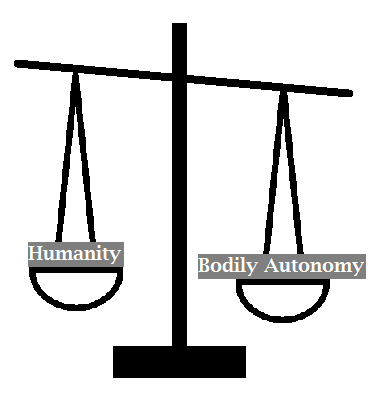
I disagree with both of the above perspectives. I think both the humanity of the fetus and the woman's bodily rights matter. In my opinion, the scale should look more like this:

One factor may still outweigh another, but it won't outweigh by as much as if there were no other factors to consider. We can certainly argue over which factor has more weight, why it has more weight, and how much more weight it has. But those are very different arguments than asserting that only one factor matters at all.

When considering only bodily autonomy and humanity, I believe one person's bodily autonomy does outweigh another person's humanity. After all, we don't require people to donate blood even if it means other people will die without blood donations. We don't do this because your bodily autonomy--your right to decide whether or not to donate blood--is considered more important than the life of a man who will die without a blood transfusion. The dying man still has his humanity--no one is saying he's not a human being--but his humanity doesn't somehow mean you can be forced to donate blood. 

Some people say this does make the dying man's humanity irrelevant. After all, whether he is human or not, you still don't have to donate blood, right? Who cares whether bodily autonomy outweighs humanity a little or a lot--in the end it still outweighs, so why even talk about humanity?

Because humanity and bodily autonomy still aren't the only factors to consider. Other factors must be added to one side of the balance or the other, and the accumulation of multiple factors may tip the scales. For example, what if the man is dying because of you? What if you consented to some action you knew risked putting his life in danger? Maybe then the scale would look more like this:


Take away any one of the factors on the left, and bodily autonomy wins out again. But the combination of factors on the left is another story.

Now, there are actually many, many more factors to consider on both sides of the scale. My point in this post is not to give an exhaustive argument for why I think most abortions should be illegal. My point is simply to say that there are a lot of factors in the abortion debate, and while some of them weigh more than others, they all weigh something. Keep that in mind.

[Re-posted at Secular Pro-Life]